
Digital Employee Advocacy in Enterprises

All enterprises I came across in MENA are keen to optimise their results on social marketing strategy through better content, optimised content workflows, localisation and many other smart ways that rely on more sustainable data sources resulting in more knowledge about users in Social CRMs  and more relevant content suggestions. At the end of this article I am suggesting a new way to reach quality audiences with brand messages.

Still today, organisation are fighting for the audience to get more reach of their content across the proprietary social platforms like Facebook, Twitter and Instagram. The natural evolution of social networks discriminates Brands that create content through Algorithms that make them pay in order to reach the consumers. As soon as enough users consume too much content on the channel, the platform creates a reach limiting algorithm and an ad sales team to override the same. These algorithms are beneficial for the relevance and therefore quality of the consumed content for the user, and improve the time the platform is consumed eventually.

Brands have been struggling creating relevant content, which is engaging enough to improve organic reach in social networks. Campaign value is low, because of the  low frequency of agencies “campaign based planning”, while a sustainable way to activate users would be more beneficial. 52 campaigns per year have been proven to be creating much higher average reach than quarterly big “activations” alongside a TV campaign.

Agencies and Brands feel the pain and move their activities to smaller but not limited platforms. Until recently for example Instagram was made popular as there was no algorithm, no ads, and just visual content to be produced while influencers can be paid off in bulk. All that changes, aside to the fact that the full reach on Instagram is probably less reach than the “algorithmed” organic reach on Facebook in several countries.

I stumbled across a way for brands to increase their reach in a conveniently controlled way, having an impact beyond only the social marketing department (which usually still has to justify its existence). Enterprises implementing employee advocacy programs into there digital strategy:

While the organic reach of a Brands post lies around 4%-6% on average, a consumer posting his on content has a much wider and less restricted organic reach of approximately 90% in his network. That means if your audience is 100 in total, a brands post will be seen by 4 persons, while a consumer share will result in 90 persons seeing this post. that is why it is so heavily promoted and appreciated that users share brands content.

What if this sharing process can be stipulated, institutionalised, controlled and tracked for these kind of influencers. What if this even allows to incentivise the proactive execution of   sharing in this closed environment? What if brands make use of the assets they are currently already using already for business success – their employees.

Just assume there is a controlled ecosystem in which the employees of big enterprises can access a centralised content pool to share from on a daily basis. Imagine that this content pool falls under the strict control and approval of the centralised content team in the organisation. On a daily basis the employees are encouraged and incentivised to share the provided and approved product information, offers, professional content, job vacancies or any other landing pages for conversions in their network. Incentives can be included in the HR department as an element of the compensation plan, additional holidays, loyalty program credits or other catalogue based internal benefits.

While the employees are actively involved in this already in northern European countries as far as I know, the fewest enterprises in MENA have even considered this kind of strategy, enabled though technology.

I would be glad if you prove me wrong and tell be where this is deployed already ?

Let me know.
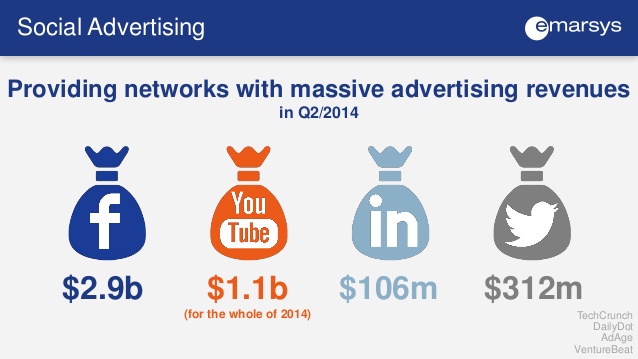


The revenue evolution of social networks

The past 4 years i have interacted with hundreds of Digital and Brand managers as well as with media planners and agency representatives. In our discussions we have interacted around social networks reach and audiences, social network preferences etc.

Around 2010, Facebook has grown to become ubiquitous globally. Millions of consumers signed up and shared content with each other. Brands & publishers jumped the bandwagon in order to produce content these users are supposed to engage with. The content each individual was unfiltered, based on the individuals Facebook friends and Brand “likes”. With a 100 friends and 100 Likes, each of the 200 sharing only one piece of content per day, the Facebook feed was cluttered with 200 unfiltered content pieces, no matter how (ir)relevant that piece of information is for the individual.

 Around 2012, the whole industry, as well as the consumers, have been confronted with the introduction of an algorithm based “Facebook feed clean up mechanism” called “Edge Rank”. This algorithm was supposed to filter content for the newsfeed based on relevance for the individual, as more users stay obviously on Facebook if the content is interesting/relevant to them.

This “Edge Rank algorithm” has been adapted several time and is not the topic of this article. Interesting enough it represents an important step in the ability to monetise social networks and has been replicated in other prominent cases over and over again. My assumption is that it will replicated for any social network mechanism.

Social Network growth phase

Any  social network is following pretty much the same phases of development from my experience. While market penetration happens through massive capital injections based on venture capital invested in technology backend and user acquisition, the target of this is to create a massive “installed user base” that evolves in reaching a critical mass of users. The massive growth, also stipulated through viral networking effects inherent to Social networks, will first lead to a gain of quality of the social network.

The virtuous and vicious critical mass

But with more contributors in the network, the consumed content will lack relevance as interests and taste as well as preferences for friends, content and brands are evolving over time. So the CN either cleans up or the users will leave the network as the content value decreases.  Every growing social network is facing this. Facebook has been through this at an earlier stage then others. They deployed an algorithm that filters out irrelevant content to keep individuals newsfeed relevant.

Revenues finally for social networks

A positive side effect is that it opens up the possibility no enrich the business model of the social network with an additional revenue source: If content is filtered by an algorithm, there will always be companies that will pay to override this mechanism in order to reach their audiences. Advertising revenues are skyrocketing, but brands start to complain that they have a very small organic reach that is limited more and more, while they have to allocate massive funds to paid reach advertising campaigns.

Brands nomading to “free” platforms

My clients and partners kept permanently emphasising the low organic reach they got out of Facebook then, which convinced them to move into other, just emerging, platforms like twitter and Instagram. Here they found all the “free” audience and reach, all of a sudden preferring activities here to promote to easier, less targeted and smaller audiences.

Then, as Twitter was emerging in user numbers, they announced an algorithm as well. And this is followed by a global rollout of self service advertising ability for the long tail advertising. Now one week ago Instagram has announced the same concept and all of the sudden Instagram is declared to be “dead for brands

It is just natural development, an evolutionary process from my perspective. I assume now it will have the implication that more brands move back to Facebook as all relevant channels have now algorithms – while Facebook still has a much more efficient targeting,  ore data and generally a much wider audience.

What do you think about this?